
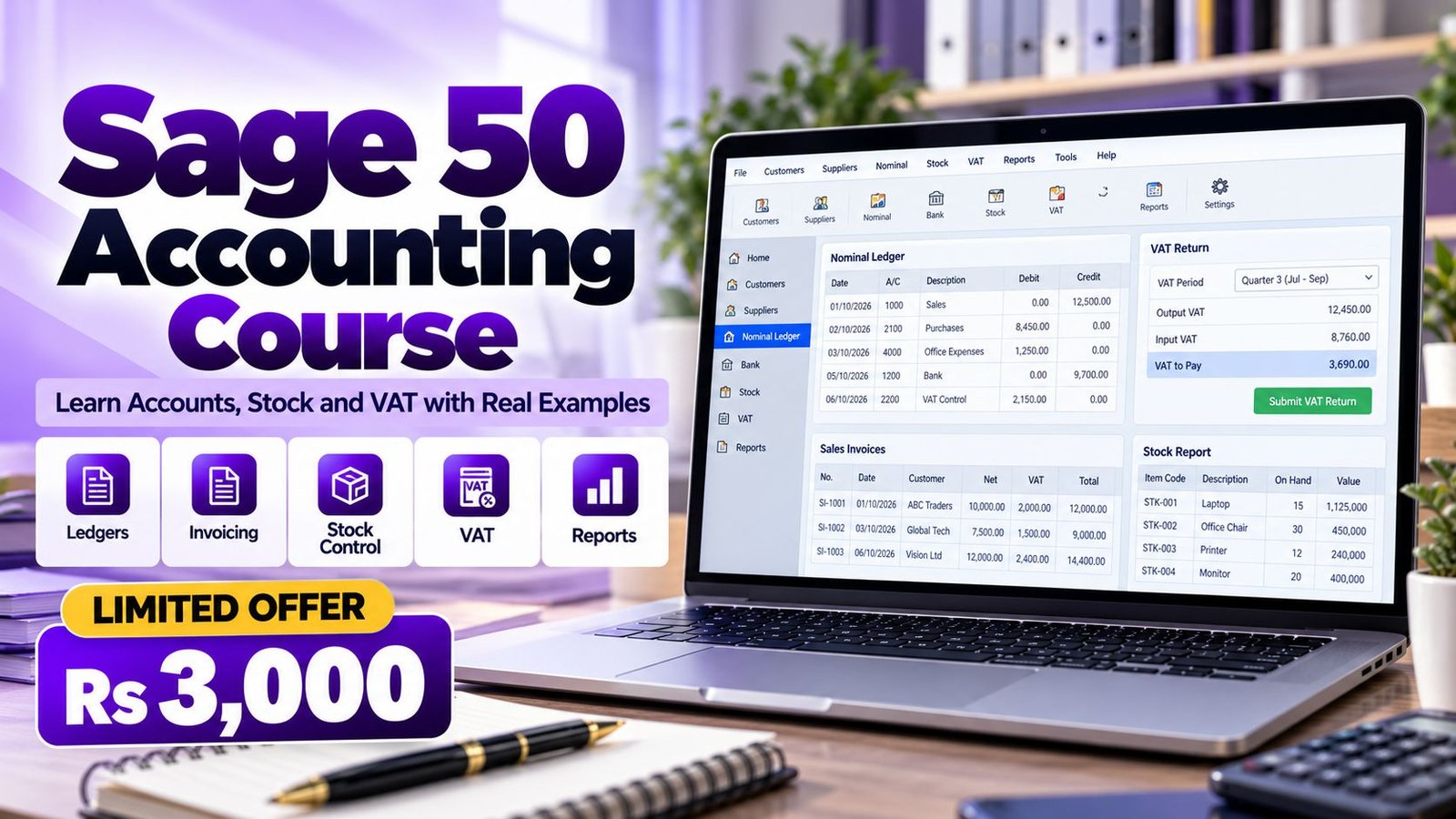
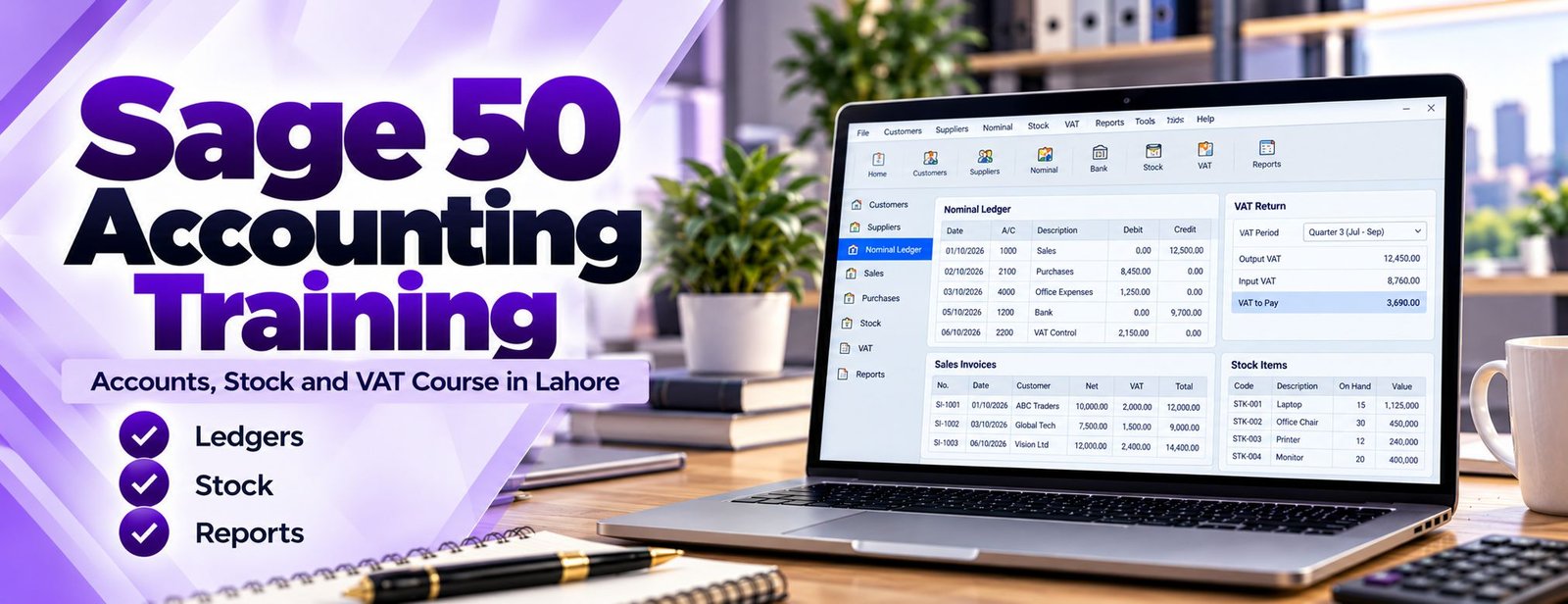
Sage 50 – widely remembered as Sage Line 50 – is a long-established accounts package among small and medium businesses, particularly in the UK. Sage Line 50 Training in Lahore at Accountech covers the journey an accounts officer takes every month: create the company, load balances, post sales and purchase transactions, handle stock, correct mistakes and produce reports.
A quick note on names, because it confuses many learners. In the UK and Ireland the product was sold as Sage Line 50 for years and is today called Sage 50 Accounts. In the United States, “Sage 50” is a different product line that began life as Peachtree. This course follows the UK-style accounts workflow – nominal ledger, customers, suppliers, products and VAT-aware transactions – which is the lineage most Pakistani employers and UK-linked clients mean when they say “Sage”. If you are specifically after the American edition, see our Peachtree and Sage 50 US training.
The course is built around practice, not menu tours. You work through a trading company from installation to month-end, then a manufacturing company project with raw materials, finished goods and a bill of materials. Whether you sit in DHA, Gulberg, Johar Town, Model Town or anywhere else in Lahore, the recorded lessons let you study at your own pace and replay anything that did not click the first time.
If you are still comparing packages, look at our Tally training, QuickBooks training and the full list of computerized accounting courses in Lahore. Many students finish one package and add a second within a few months, because the accounting logic carries across.
The following topics are included in your Sage 50 training. The modules follow the order of real work: set up first, post daily transactions next, then correct, reconcile and close the month.
You start from zero: getting the software installed, understanding what a company file is and learning to move around the program confidently.
A clean chart of accounts is the foundation of every report you will ever run. This module shows how to build it and how to bring a business onto the system correctly.
Receivables, payables and stock are where most small-business accounting effort goes. Here you load all three and make sure they agree with the ledger.
This is the largest practical block. It mirrors the variety of entries an accounts assistant sees in a normal week, not just textbook sales and purchases.
Businesses rarely go straight from enquiry to invoice. This module covers the document flow before and after an invoice, plus the controls that protect cash.
Mistakes are normal; hiding them is not. You learn how to put things right in a way that an auditor or manager can follow.
The manufacturing project shows how stock, cost and ledgers interact when a business makes what it sells. It is the module that most clearly separates this course from basic bookkeeping tutorials.
The final module collects the situations that separate a confident user from a hesitant one, including cases that are easy to get wrong.
Sage 50 Accounts is accounting software from Sage for small and growing businesses. The vendor’s own description, including current plans and features, is on the official Sage 50 Accounts product page. In that listing Sage highlights capabilities such as quotes and invoices, tracking stock, automatic bank reconciliation, bespoke reports and tools for Making Tax Digital for VAT in the UK. Features and plan names change over time, so always treat the vendor page as the authority for the latest edition.
Historically the UK product was known as Sage Line 50; the name was later shortened to Sage 50, and it has also been marketed under cloud-related names. The US “Sage 50” is a separate line that began as Peachtree – see the vendor’s US Sage 50 page if you want to compare. Because the screens and plans differ between editions, we teach the accounting workflow that stays the same: set up, post, correct, reconcile, report.
The lessons use realistic situations – customer advances, early settlement discounts, credit limits, returns and corrections. These are the cases where a trained user is most valuable, because they are the ones that produce wrong balances when handled carelessly.

Associate Charted Certified Accountant (ACCA)
Learn from Saad Nadeem, ACCA, who has implemented accounting software for companies and trained thousands of learners, so examples come from real office practice rather than theory alone.
Online lessons and a one-month plan fit around a job, a university schedule or a business you are already running. Replay any lecture as often as you need.
Month-end close, corrections, returns and stock handling mirror daily office work, so you practise the tasks employers actually ask about.
Two complete company exercises show you both a buy-and-sell business and a business that converts raw materials into finished goods.
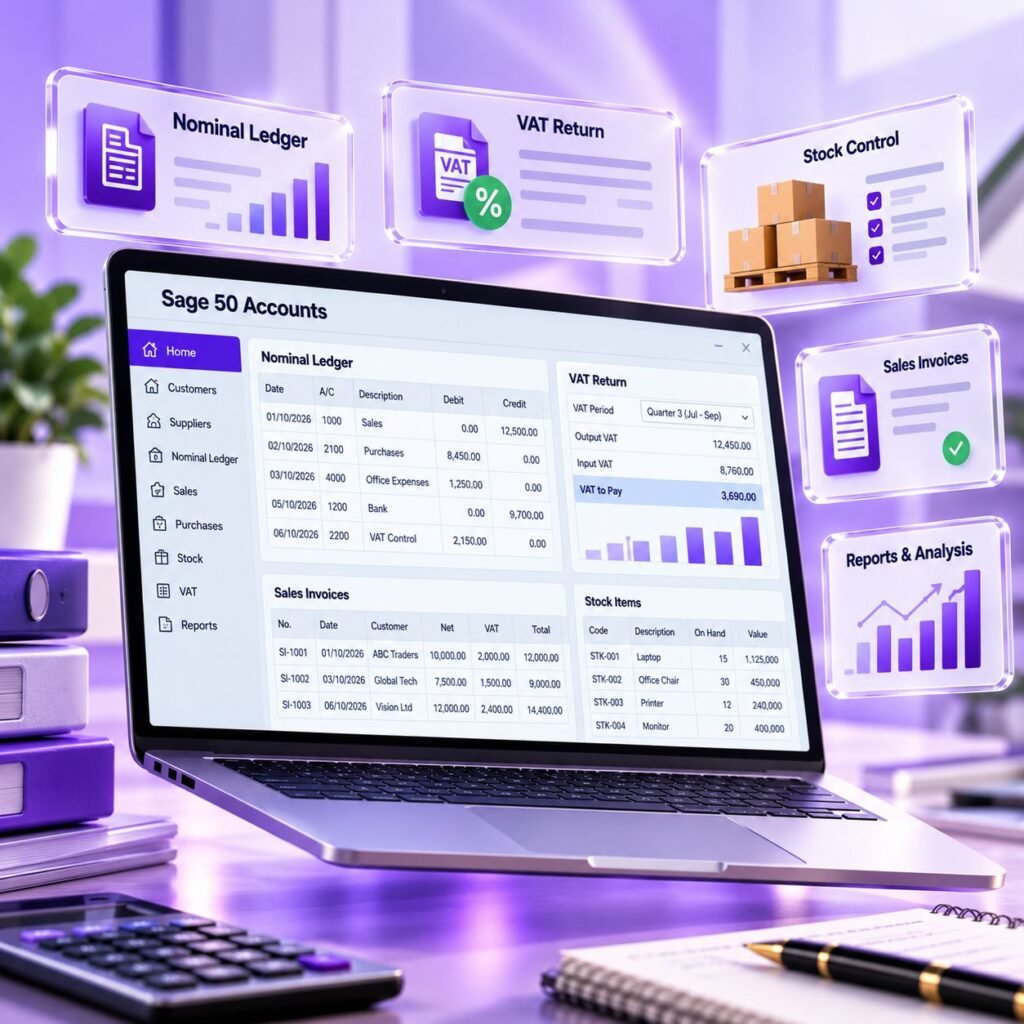
We teach Sage as an accountant would use it. That means you reconcile the opening trial balance before posting, extract and reconcile month-end reports, and correct errors properly instead of deleting evidence. These habits matter in audited environments, where someone will eventually ask why a balance changed and expect a clear trail.
Many short courses show you where the buttons are and stop there. Here the emphasis is on why each entry is made, so you can adapt when a company has a slightly different chart of accounts, a different stock policy or a different customer arrangement. If you understand the debit and credit behind each screen, switching between packages becomes much easier.
The course finishes with a manufacturing company project that shows how stock, cost and ledgers interact. Along the way you build a small portfolio of practice company files that you can open in an interview and walk through step by step.
Prefer another route? The same approach is used in our QuickBooks course, so you can compare how two packages handle the same business event.
Sage knowledge gives you another recognisable item for your CV, especially if you aim for UK-linked firms or companies with Sage-based clients. It also strengthens your fundamentals – ledgers, inventory and reconciliation – which transfer to every other package.
For business owners the benefit is practical: you can read your own reports, ask better questions of your accountant and spot posting mistakes before they reach a tax return. If you want to analyse the exported figures in more depth, our Advanced Excel training pairs naturally with this course.
After your practical training with Accountech Training & Solutions you will be able to:
You receive a certificate of completion from Accountech once you finish the course. It confirms that you completed the training; it is not a licence or an exam issued by Sage or any outside body, and we do not present it as one.
What persuades an employer is usually what you can show. Keep your practice company files and the reports you produced, and be ready to explain how you reconciled them. For edition-specific features and the latest plans, review the vendor’s official Sage 50 Accounts product page.
There is no single document that proves Sage ability, so combine several kinds of evidence:
Hiring managers see many CVs that list software names. Concrete evidence separates you from them. Benefits include:
Sage training is less common locally than Excel or Tally, so choose a provider that teaches workflow rather than menus. Ask to see the outline, and check that it covers the full cycle from company creation to reconciled reports, not just invoice entry.
Look at the trainer too. Accountech courses are taught by Saad Nadeem, ACCA, and our Udemy edition of this course is available for you to preview before you commit. If you are comparing several accounting packages, our computerized accounting courses page lists the options side by side. We also offer Advanced Excel to help with analysis after posting, and Xero training if your target employers use cloud-first software.
Whatever provider you choose, ask these questions before paying:
A good course answers yes to most of these. Be cautious about any programme that promises a job or cannot show its outline.
Accountech offers Sage Line 50 training for Rs 3,000. The planned duration is one month, and the Udemy edition includes lifetime access and 20 downloadable resources.
What the fee gives you:
One month is a realistic pace for someone who studies a few evenings a week: roughly one module every few days, with time left to repeat the exercises. Because access is for life, you can come back later and refresh a topic when a job actually requires it. To join, use our enrollment page or message us on WhatsApp.
Training is online, so you can learn from anywhere in Lahore without travelling through traffic to a classroom:
Video lessons
84 lectures to replay whenever you like, on computer, mobile or TV.
Practice projects
A trading company and a manufacturing company that you build yourself, step by step.
Downloadable resources
20 files to practise with alongside the lectures.
Support
WhatsApp 0331-8433334 for enrolment help and guidance, and our office at 182-Y Block, DHA Phase 3, Lahore for those who want to talk in person.
A sensible routine is to watch a lecture, pause, repeat the entry in your own practice company and then compare your report with the one on screen. Learners who only watch tend to forget; learners who post along retain far more.
Sage skills help in roles such as accounts assistant, accounts officer, bookkeeper, stock accountant and finance support for UK-linked organisations. We do not quote salary figures because they vary widely by employer, experience and city. Here is what each role typically does with the software:
Employers generally look for accuracy, a habit of reconciling, and the ability to explain an entry. A Sage module on its own will not replace core accounting knowledge, so pair it with a qualification or solid fundamentals. Many learners also add Tally or Excel skills to widen the roles they can apply for.
Sage is used mainly by small businesses in markets such as the UK and Ireland, so Sage competence can help with international clients and remote bookkeeping work. Pakistani accountants who understand how a UK-style ledger, customer and supplier structure works find it easier to communicate with overseas clients.
Remember the limits. VAT rules differ by country, and tax compliance in the UK follows HMRC requirements that change over time, so always follow the client’s local requirements and the vendor’s current documentation. This course teaches the accounting workflow; it does not replace tax advice.
If you plan to work with several overseas systems, you may also like our Xero and QuickBooks courses, which are widely used with freelance and remote clients.
Local demand for Sage is modest but real. It appears in firms with UK or international affiliations, in companies that inherited Sage from an overseas parent or client, and among accountants who serve small businesses and want one more package they can support. Lahore’s business areas – Gulberg, DHA, Johar Town, Model Town and the industrial zones – are home to a mix of trading and manufacturing companies, so both halves of this course are relevant.
Freelancers can also look at small overseas clients who need part-time bookkeeping. Treat any such work carefully: agree the scope, understand the client’s VAT arrangements and keep clear records of what you posted.
Companies that want several staff trained together can arrange a tailored batch through corporate training. Questions about a specific situation can go through our contact page.
Planned duration is one month. The recorded course has 84 lectures and about 5 hours of video, so most learners finish comfortably within that time by studying a few evenings a week.
The fee is Rs 3,000. This includes lifetime access to the Udemy edition, 20 downloadable resources and a certificate of completion.
They are closely related. Sage Line 50 is the older UK name, and the product is now called Sage 50 Accounts. The US “Sage 50” is a different line that began as Peachtree, so check which edition your employer uses.
Yes. Inventory with opening stock, units of measure, returns, stock losses and bills of materials are covered, including in the manufacturing company project.
Yes. It begins with installation and company creation and builds up gradually. Basic accounting knowledge such as debits and credits will help, but you do not need prior Sage experience.
The course teaches VAT-ready transactions as part of the workflow. VAT rules differ by country and change over time, so you should always follow the client’s local requirements and the vendor’s current documentation.
You receive a certificate of completion from Accountech. It confirms that you finished the training and is not presented as an exam or licence from Sage or another outside body.
Yes. The lessons are recorded, so you can learn in the evening or on weekends and replay anything you missed. Posting the practice entries yourself is the best way to retain the material.
Lessons use Sage 50 and the workflow applies across versions. Menu names and plan features can differ between editions, so check the vendor’s product page for what your edition includes.
Message 0331-8433334 on WhatsApp, visit our enrollment page or use the enquiry form. You can also visit our office at 182-Y Block, DHA Phase 3, Lahore.
Take time to reconcile each report and replay lessons where needed. Sage rewards methodical users. If you cannot find your answer here, send us a message on WhatsApp at 0331-8433334 and we will help you choose the right course.
 Posted on Google
 usama ali
Trustindex verifies that the original source of the review is Google.
This course was good for beginnersPosted on Google Umair IqbalExcellent training experience! The trainer explained everything very clearly, and the session was informative, practical, and easy to understand. This is a very useful basic skill, and I believe everyone should learn it. Highly recommended!Posted on Google
 Waqar AliAccountech Training & solutions offers best practical courses they are really easy and beginners friendly with highly advanced skills and well-traned teachersPosted on Google
 Muhammad TariqBest Accounting material, I gained best knowledge and experience with Accoutech and also received E-certificate.Posted on Google
 Usama AsifI have completed my excel course. According to me, It is very helpful for the professional and highly recommend to all of you to gain your skills and become more competitive for the job marketPosted on Google
 Nasir AyoubI bought the Excel course and it exceeded my expectations. The content and teaching quality were outstanding. I also enrolled in other courses, and all are 5/5. Highly recommended for anyone who wants to learn practical skills.Posted on Google
 Jamshaid Ameer ShahExcellent mode of learning Best Teaching/Guidance 100% RecommendedPosted on Google
 ZA RizwanWith "Accountech Training & Solution" An absolutely wonderful and amazing training experience—truly inspiring and full of valuable learning! 🌟 Thanks Accountech & team.
