
Abbottabad’s students, who often study far from big-city training centres, can join an online Python course without moving. Learning in Urdu/Hindi keeps the ideas simple, and the trainer is reachable on WhatsApp.
Accountech’s online Python course gives beginners in Abbottabad a gentle path into programming. Ideas are explained in Urdu/Hindi, shown in code and then practised through exercises. The month covers variables, decisions, loops, collections, functions, files and error handling, and finishes with small projects.
Treat this as a first step. You will finish with working mini projects, clear basics and a plan for what to study next, but no course can promise a job. If spreadsheets are part of your work, Excel training is a good companion.
The following topics are included in your Python training. Each module builds on the previous one, and every module ends with practice tasks so that you write code instead of only watching it.
Before writing logic you need a working setup and a clear picture of what happens when code runs. This module removes the fear of the first day.
Variables are the memory of a program. Here you learn how Python stores information and how to calculate with it.
Programs become useful when they can choose between actions. This module teaches Python to make decisions the way you would.
Loops let you do in one second what would take an hour by hand. You will learn both loop types and when to choose each.
Names, addresses, invoice text and messages are all strings, so text handling is a skill you will use constantly.
Real data comes in groups. This module covers the four built-in collections and helps you decide which one fits a problem.
Functions stop you from repeating yourself and make programs easier to read, test and fix.
Useful programs read and save information, and they must not crash when something unexpected happens.
Python comes with a large standard library. You will learn how to use code that others have already written, without going deep into any one tool.
The final module brings everything together. You build small, complete programs and learn how to present them.
Python is a general-purpose, high-level language maintained and developed by an open community under the Python Software Foundation. It is known for readable code: instead of heavy punctuation, Python uses indentation and plain English-like keywords, which is why many schools and universities choose it as a first language.
The language is used for automation scripts, data analysis, web applications, testing, scientific work and teaching. As a beginner you do not need to touch all of that. You need a clear base in how programs store data, make decisions, repeat actions and organise code, and that is exactly what this course focuses on. The official Python for Beginners page is a good place to see the wider ecosystem, and the official Python tutorial is a useful companion once you finish the course.
Our teaching approach is simple: explain the idea in Urdu/Hindi, show it in code, then ask you to change the code and break it on purpose. Learning to read an error message is part of learning Python, not a sign that you are failing.

Associate Charted Certified Accountant (ACCA)
Saad Nadeem explains each concept with business-style examples, so ideas like loops and functions connect to work you may already do.
Urdu/Hindi explanation removes the language barrier, while code and documentation stay in English so you are ready for real-world material.
You write code after every topic, not only at the end. Mistakes are treated as part of learning.
A one-month plan you can follow from home, with WhatsApp support on 0331-8433334 when you get stuck.
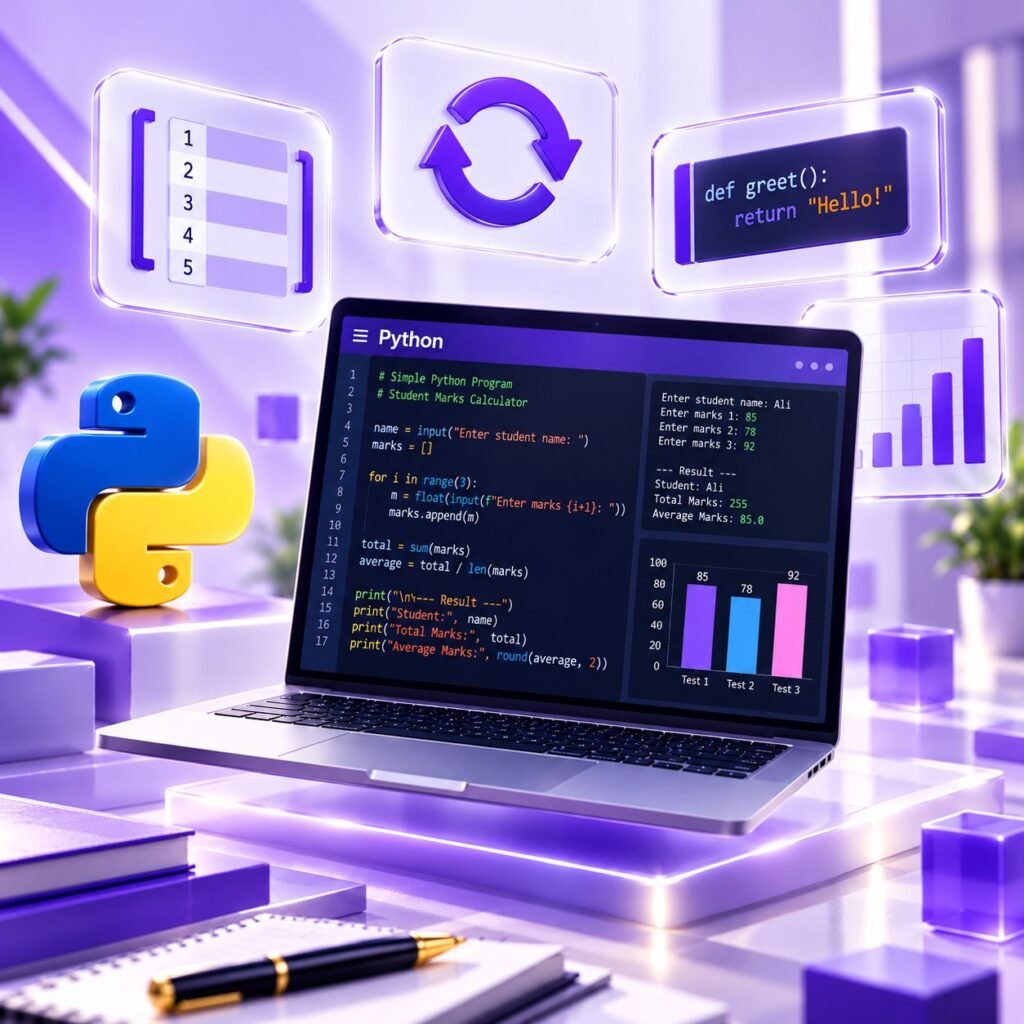
A beginner course should reduce fear, not add to it. That is why we choose small programs with a clear purpose, explain each line in plain words and repeat the key ideas in different forms.
Learners with an accounting background can pair this with computerized accounting training.
Beyond the language itself, this course builds habits that help in any technical or analytical role: planning before coding, testing small pieces, reading error messages calmly and keeping code tidy.
Many learners also notice they become faster with everyday tasks, since small scripts can handle repetitive jobs. For those in finance, Advanced Excel and Power BI are natural companions. None of this guarantees a job, but it gives you a sound base to keep learning.
You do not need a computer science degree or prior coding experience. Basic computer use, such as installing a program and managing files, is enough to begin.
Expect these practical outcomes:
At the end you receive a certificate of completion from Accountech confirming that you completed the beginner programme. Please treat it as a training record rather than an official qualification.
What interviewers and clients usually want is a conversation about your code: why you used a loop here or a dictionary there. Your projects will help you do that.
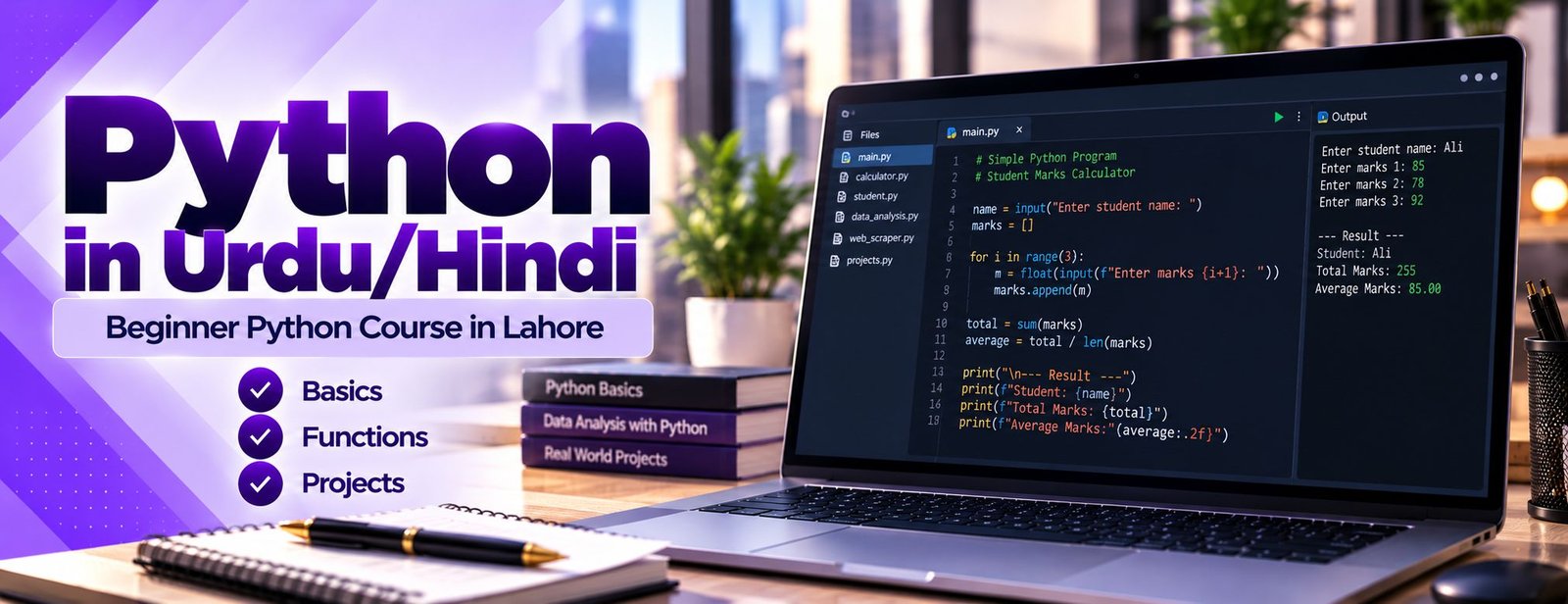
Why build mini projects during the course?
Start simple, then add one feature at a time.
Learners in Abbottabad can choose from university electives, private institutes and free online videos. The right option depends on your background, budget and discipline. If you tend to drop self-study, a structured course with a trainer you can message is often worth more than hundreds of hours of unorganised videos.
Accountech’s Python course is intentionally small: one month, beginner level, Urdu/Hindi explanation. Talk to us on WhatsApp before enrolling, or see our MS Office course if you need computer basics first.
Questions worth asking any provider:
Be careful with promises of guaranteed jobs or high income from a short beginner course.
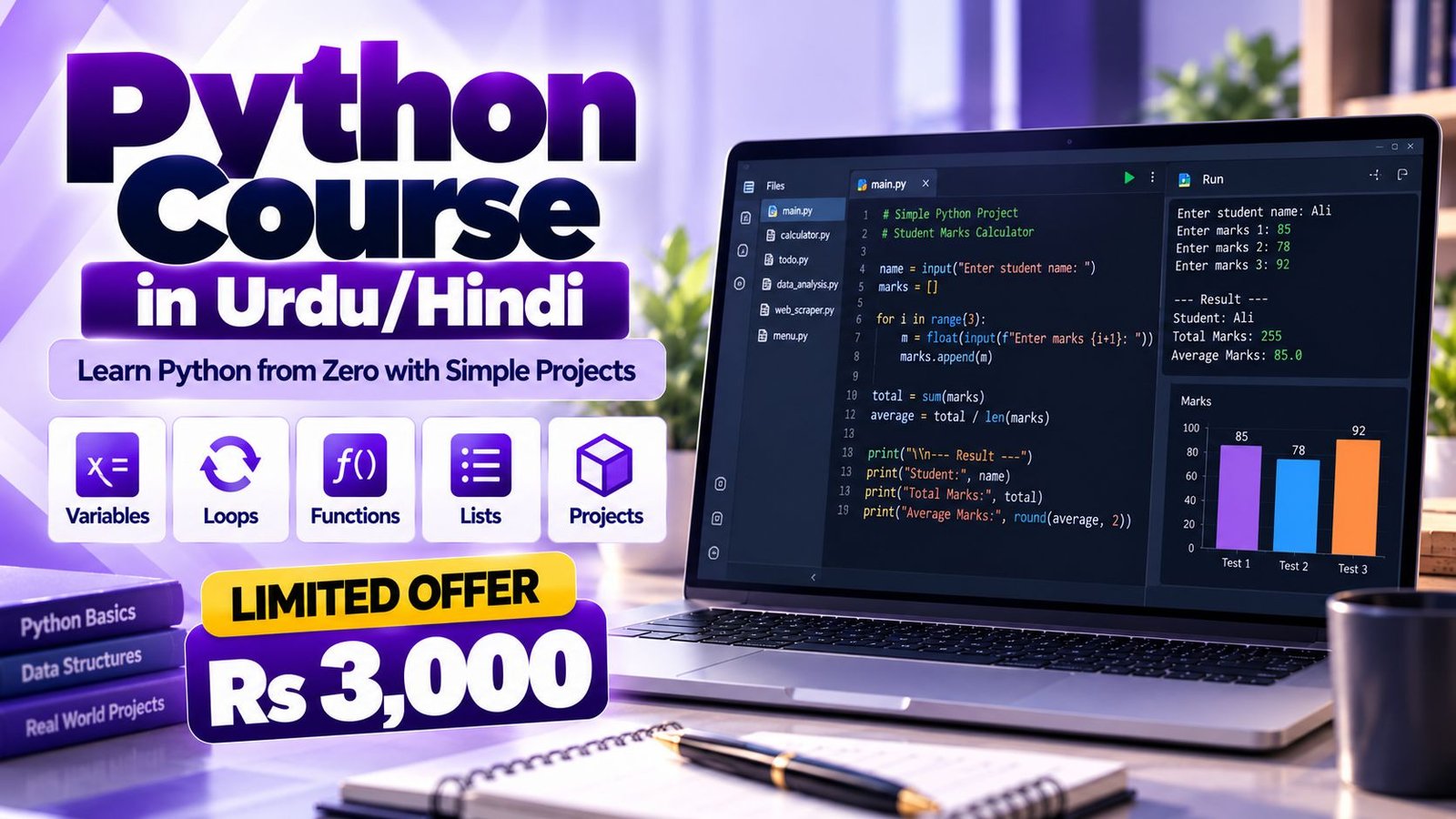
The Python course in Urdu/Hindi costs Rs 3,000 and runs for one month at beginner level, so no programming background is required. The fee covers online training, exercises, mini projects, the certificate of completion and WhatsApp support.
To enrol, message us on WhatsApp 0331-8433334 (+92331-8433334) or use the contact page. A free demo class is available if you want to try the teaching style first.
The course is delivered online so you can learn from anywhere in Abbottabad or beyond, without travelling. A typical learning flow looks like this:
Code-along lessons
Each topic is explained in Urdu/Hindi, and you type the same code as the trainer, pause, run it and experiment.
Exercises after every topic
Short tasks check that you understood. You attempt them on your own first, then compare with the explanation.
Mini projects
As the course progresses, small projects combine several topics, such as functions with lists and files.
Support
Send questions, code snippets or error screenshots on WhatsApp 0331-8433334 and get guidance on what to check next.
For best results, set aside 45 to 60 minutes daily, keep a notebook of errors you solved, and avoid skipping the practice tasks. Teams and institutions that want a group session can ask about corporate training.
A one-month beginner course is a starting point, not a finish line. It will not make you a software engineer by itself. What it does is give you the base to learn further and to start using Python for small, practical tasks. Depending on your background and the extra study you do, Python can lead towards roles such as:
What employers and clients usually look for is not a certificate alone. They look for clear logic, working projects, comfort with errors, and a willingness to keep learning. We do not quote salary figures here because pay varies widely by employer, role and experience, and a beginner course alone does not set your earning level.
Python is used by developers, analysts, researchers and educators across the world, so the skills you build are transferable beyond Pakistan. Online freelancing platforms regularly list small tasks that involve scripting, data cleaning or simple automation, and remote teams often accept contributors from different countries.
That said, global opportunities are competitive. Most international employers and clients expect more than the basics: comfort with a library or framework, version control, English communication and a portfolio of real work. Think of this course as the first step on that path. A good next plan is to finish the basics, build three to five projects, learn one area in depth (for example data analysis or web development), and then start applying for internships or small freelance tasks.
If your interest is more on the finance and markets side, you may also like our Forex trading course, where analytical thinking is equally important.
Abbottabad’s colleges, schools and hospitality businesses, along with students who live far from large training centres, benefit most from online learning.
Common situations where Python basics help include:
Because the lessons are online, you can attend from anywhere in Abbottabad. Schools, offices and training groups can arrange sessions through our corporate training service.
The fee is Rs 3,000. It covers the online training, exercises, mini projects, certificate of completion and WhatsApp support.
Yes. The course starts from installation and the very first program, and assumes no coding background. You only need basic computer skills.
Variables and data types, operators, conditions, loops, strings, lists, tuples, dictionaries, sets, functions, file handling, error handling, an introduction to modules and mini projects.
Not by itself. The course gives a strong foundation and a few projects, but most tech roles need further study, such as data libraries or a web framework, plus regular practice.
No, this is a beginner programming course. It gives you the basics that those fields depend on, and we introduce what libraries do so you can decide where to go next.
Yes. Many learners from commerce and finance backgrounds find Python easier than expected, especially with Urdu/Hindi explanation. It can later support automation and reporting alongside tools like Advanced Excel.
Small daily practice beats occasional long sessions. For anything not covered here, write to us on WhatsApp 0331-8433334 or use the contact page.
 Posted on Google

 usama ali
Trustindex verifies that the original source of the review is Google.
This course was good for beginnersPosted on Google Umair IqbalExcellent training experience! The trainer explained everything very clearly, and the session was informative, practical, and easy to understand. This is a very useful basic skill, and I believe everyone should learn it. Highly recommended!Posted on Google
 Waqar AliAccountech Training & solutions offers best practical courses they are really easy and beginners friendly with highly advanced skills and well-traned teachersPosted on Google
 Muhammad TariqBest Accounting material, I gained best knowledge and experience with Accoutech and also received E-certificate.Posted on Google
 Usama AsifI have completed my excel course. According to me, It is very helpful for the professional and highly recommend to all of you to gain your skills and become more competitive for the job marketPosted on Google
 Nasir AyoubI bought the Excel course and it exceeded my expectations. The content and teaching quality were outstanding. I also enrolled in other courses, and all are 5/5. Highly recommended for anyone who wants to learn practical skills.Posted on Google
 Jamshaid Ameer ShahExcellent mode of learning Best Teaching/Guidance 100% RecommendedPosted on Google
 ZA RizwanWith "Accountech Training & Solution" An absolutely wonderful and amazing training experience—truly inspiring and full of valuable learning! 🌟 Thanks Accountech & team.
Related courses at Accountech Abbottabad:
Python course in Urdu/Hindi in other cities:
